 info@globaxsolutions.com
  +91-790-200-2800
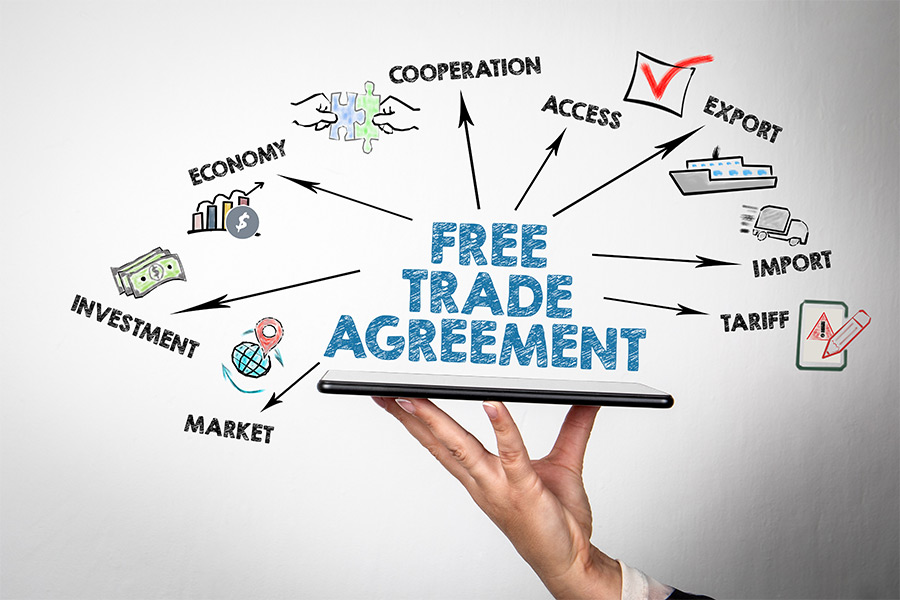
How India’s Trade Agreements (FTAs & CEPAs) Give You a Competitive Edge
Understanding the Different Types of Agreements
India’s agreements are structured to offer different levels of market integration:
| Type of Agreement | Primary Focus | Key Benefit | Example |
| Preferential Trade Agreement (PTA) | Tariff reduction on a select, agreed-upon list of products (Positive List). | Provides initial, limited tariff concessions. | India–Chile PTA |
| Free Trade Agreement (FTA) | Elimination or substantial reduction of tariffs on most products traded between partners. | Lowers your cost significantly, making you price-competitive. | India–Sri Lanka FTA |
| Comprehensive Economic Partnership/Cooperation Agreement (CEPA/CECA) | The most integrated form. Covers Goods, Services, Investment, IPR, and Regulatory Cooperation. | Provides holistic business advantages beyond just goods (e.g., easier visa access for professionals). | India–UAE CEPA, India–Japan CEPA, India–Australia CECA |
The Big Four: Recent and Strategic Agreements for Indian Exporters
Indian negotiators are constantly expanding the trade network. As an exporter, you must be aware of these strategic agreements:
1. India-UAE Comprehensive Economic Partnership Agreement (CEPA)
Significance: A high-impact agreement that gives immediate zero-duty access to a vast majority (over 97%) of Indian exports to the UAE.
The Global Gateway: The UAE is a massive re-export hub. Using CEPA to ship goods duty-free to the UAE means your goods become cheaper for onward shipping to Africa, Europe, and the Middle East.
2. India-Australia Economic Cooperation and Trade Agreement (ECTA / CECA)
Significance: Provides immediate zero-duty access to nearly all lines of Indian exports to Australia. This is a game-changer for textiles, leather, jewelry, and specific engineering goods.
The Advantage: Instantly lowers the cost for Australian buyers, accelerating sales volumes.
3. India-Japan CEPA
Significance: While a more established agreement, it offers deep concessions not only on goods (machinery, auto components) but also on services (IT and professional services).
The Hidden Value: Focuses on technology transfer and value-chain integration, making Indian products a crucial part of Japan’s global supply chain.
4. India-EFTA Trade and Economic Partnership Agreement (TEPA)
Significance: A groundbreaking agreement with the European Free Trade Association (EFTA)—Switzerland, Norway, Iceland, and Liechtenstein. It provides access to highly developed, high-value markets.
The Future: Expect significant market opening for Indian pharmaceuticals, machinery, and textiles into these lucrative European economies.
📝 The Non-Negotiable Compliance: Rules of Origin (RoO)
You cannot claim the reduced tariff benefit of any trade agreement without proving your product is genuinely ‘made in India.’ This is governed by the Rules of Origin (RoO).
The RoO chapter in every agreement is the most crucial part. It defines:
Change in Tariff Classification (CTC): The raw materials imported to make your product must belong to a different HS Code classification than the final exported product.
Regional Value Content (RVC): A specified minimum percentage of the product’s value must be added or accrued in the exporting country (e.g., 35% of the final cost must be sourced or processed in India).
Contact us for more details of & Your registration
Our team will be happy to assist you
Mobile: +91-790-200-2800