 info@globaxsolutions.com
  +91-790-200-2800
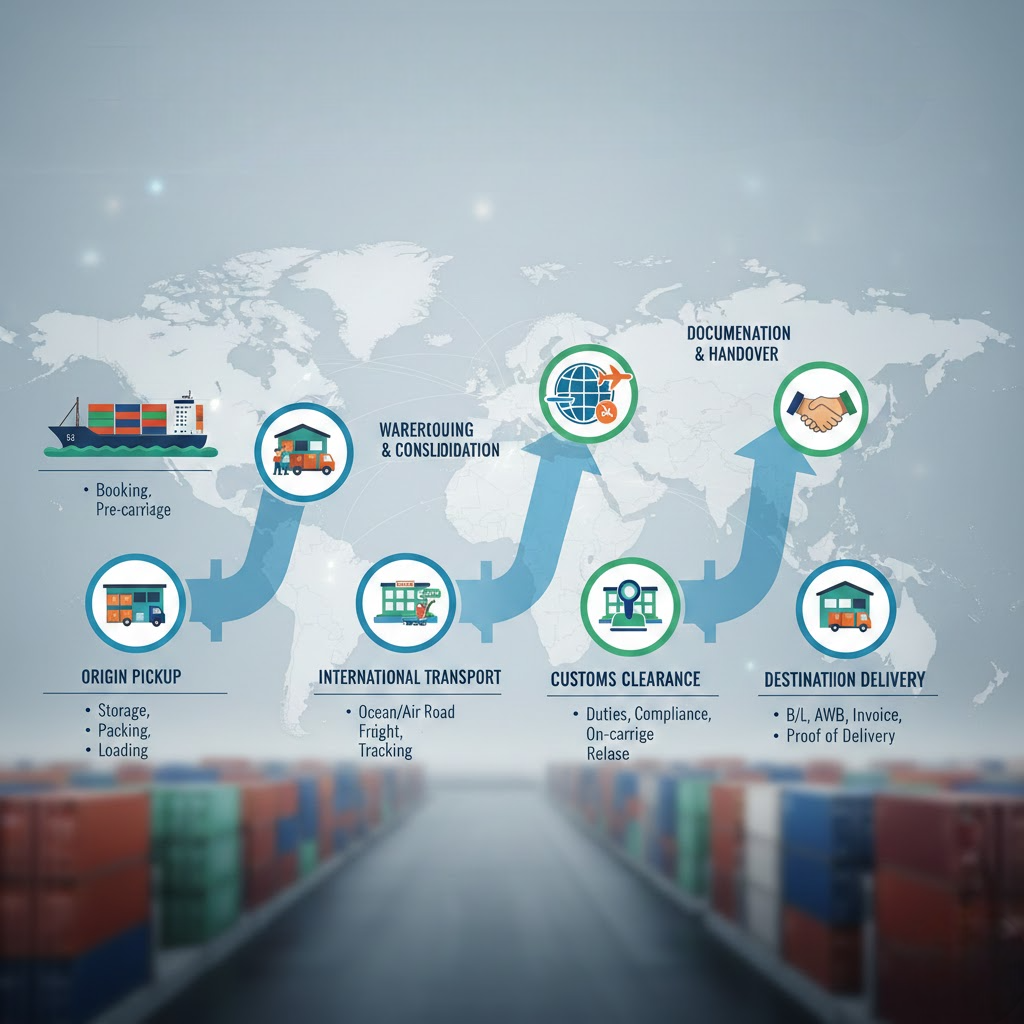
The 7-Step Freight Forwarding Process
The Freight Forwarding Process: A 7-Step Journey
Step 1: Booking & Planning 🗓️
The process begins when you, the shipper, place a booking with us. We collect all necessary details, including:
Cargo Details: Dimensions, weight, volume, and commodity (including the essential HS Code).
Incoterms: Defining the division of costs and risks (EXW, FOB, CIF, DAP, DDP, etc.).
Mode of Transport: Determining the best option (Air Freight, LCL/FCL Sea Freight, or Multimodal).
Based on these details, we select the optimal carrier, negotiate the best rate, and secure the necessary space (slot booking).
Step 2: Documentation & Compliance 📝
This is the most critical stage for avoiding delays. We ensure every document is accurate, compliant, and ready for all parties involved. Key documents include:
Commercial Invoice & Packing List: Detailing the goods and their value.
Bill of Lading (B/L) or Air Waybill (AWB): The contract of carriage and title to the goods.
Certificate of Origin (CoO): Required for preferential duty treatment.
Insurance Certificate: Arranged to protect the cargo against loss or damage.
Step 3: Origin Logistics & Consolidation 📦
Once all documents are prepared, we manage the movement of goods from your warehouse to the carrier terminal (port or airport).
FCL (Full Container Load): We coordinate the pickup of the full container from your location.
LCL (Less than Container Load): We take your cargo to a Container Freight Station (CFS) or warehouse for consolidation. Here, it is combined with other compatible shipments heading to the same destination to fill a container, offering cost savings.
Step 4: Main Carriage (Transit) 🚢
The physical transport of the goods on the main vessel (ship or aircraft) begins.
The carrier issues the official Master Bill of Lading (MBL) or Master Air Waybill (MAWB) to the freight forwarder.
We issue the House Bill of Lading (HBL) or House Air Waybill (HAWB) to you, the shipper. This is the document you use to track and manage the shipment.
During transit, we provide real-time tracking and communicate any updates or unforeseen deviations.
Step 5: Destination Customs Clearance 🛂
Upon arrival at the destination port/airport, the most challenging step begins. We work closely with our destination-side partners (our agents or branches) to manage the entire customs process:
The Consignee’s Customs Broker (CHA) files the Bill of Entry (BoE).
Customs assesses the cargo, verifies the documentation, and collects any necessary duties and taxes.
Once duties are paid and compliance checks are complete, the Let Import Order is granted.
Step 6: De-Consolidation & Unloading 🚚
After customs clearance, the goods are released from the carrier’s custody.
FCL: The container is moved directly to the consignee’s final delivery location.
LCL: The container is taken to a local CFS, where the cargo is de-consolidated (separated) from other shipments.
Step 7: Final Delivery (Last Mile) 📍
The final stage is the delivery of the goods to the consignee’s door, according to the agreed-upon Incoterms.
We arrange for the local truck or railway transport.
We ensure the consignment is safely offloaded and verified by the consignee, finalizing the contract of carriage.
The Value of a Professional Freight Forwarder
In today’s volatile market, relying solely on a carrier for a port-to-port service is risky. A freight forwarder offers essential value:
| Challenge | Solution Provided by Globax Solutions |
| Volatile Rates | Negotiate contracts with multiple carriers to provide the best market price. |
| Customs Risk | Ensure 100% compliant documentation to avoid penalties and delays. |
| Supply Chain Disruptions | Offer alternative multi-modal routes (sea-air, rail-sea) when ports are congested. |
| Complexity | Simplify the process by acting as a single point of contact for all carriers, warehouses, and customs brokers. |
Contact us for more details of & Your registration
Our team will be happy to assist you
Mobile: +91-790-200-2800