 info@globaxsolutions.com
  +91-790-200-2800
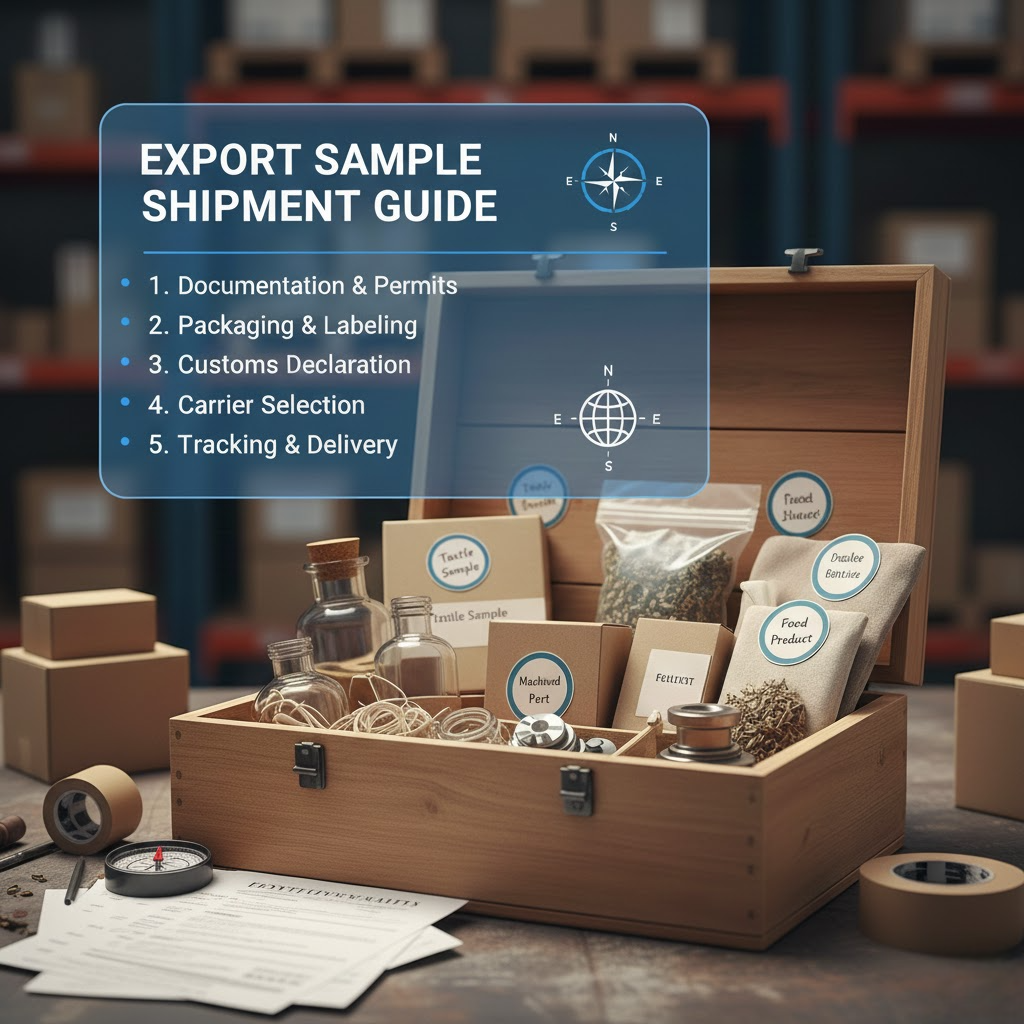
Shipping Export Samples Without Delay or Disaster
. Classifying Your Sample: Commercial vs. No Commercial Value (NCV)
The first and most important step is correctly classifying your sample for customs purposes. This determines the required documentation and duty/tax liability.
| Classification | Definition | Customs Treatment |
| No Commercial Value (NCV) | Items that are destroyed, marked, or clearly unfit for resale (e.g., small fabric swatch, marked prototype). | Usually exempt from duties and taxes, but may require specific proof. |
| Commercial Value | Items that can be resold (e.g., a full production unit, a working piece of equipment). | Duties and taxes are typically levied based on the declared value. |
2. Essential Documentation: The Pro Forma Invoice
The Pro Forma Invoice is the single most critical document for a sample shipment. It acts as the customs declaration and must be perfectly accurate to prevent holdups.
Ensure your Pro Forma Invoice includes:
Shipper & Consignee Details: Complete names, addresses, and phone numbers.
Detailed Product Description: Avoid vague terms. Specify the material, function, and clear usage.
Bad Example: “Plastic parts”
Good Example: “Small injection-molded plastic closures (polyethylene) for cosmetic bottles.”
Harmonized System (HS) Code: The correct 6-digit HS code is mandatory for global customs clearance.
Value: State the Customs Value (as discussed above) and clearly indicate the reason for export (e.g., “Sample for Testing – NCV”).
Incoterms: Always specify the Incoterm (e.g., DAP or DDP) to clarify who pays for the shipping, duties, and taxes.
3. Managing Duties and Taxes (DDP vs. DAP)
Nothing frustrates a potential buyer more than receiving a surprise bill from the courier for customs duties. This is where Incoterms become vital.
DAP (Delivered At Place): The most common term. The buyer (importer) is responsible for paying all duties, taxes, and customs clearance fees upon arrival.
DDP (Delivered Duty Paid): The exporter (you) pays all duties, taxes, and clearance fees in advance.
4. Selecting the Right Courier and Packaging
The Courier Choice
For small, urgent export samples, major international express couriers (DHL, FedEx, UPS) are almost always the best option. They provide:
Speed: Door-to-door delivery typically in 2–5 business days.
Tracking: Excellent, real-time visibility.
Customs Expertise: They handle most of the import procedures on the buyer’s behalf.
Packaging Integrity
Your product must survive a potentially rough journey across continents.
Use high-quality, dense cushioning materials.
Double-box fragile items.
Clearly label the package with the Pro Forma Invoice taped securely to the exterior.
Contact us for more details of & Your registration
Our team will be happy to assist you
Mobile: +91-790-200-2800