 info@globaxsolutions.com
  +91-790-200-2800
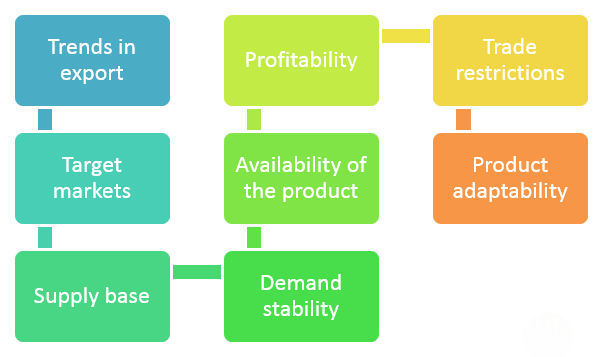
The Ultimate Guide to Export Product Selection (2025): Choosing Your Winning Item
Phase 1: Internal Analysis – What Can You Offer?
Before looking abroad, look inward.
Step 1: Assess Your Core Competencies
What is your strength? (Focus on Profitability and Sustainabilty)
Domestic Demand & Supply: Is the product consistently available in the quantity and quality required for export?
Quality Edge: Do you have a competitive quality advantage (e.g., GI Tag, unique processing, certified organic)?
Price Edge: Can you manufacture/source the product at a price that leaves a healthy profit margin even after logistics and duties?
Step 2: Scrutinize Regulatory & Logistical Readiness
Logistical Suitability: Is the product perishable, fragile, or heavy? These factors dramatically increase costs. Example: Fresh mangoes vs. dehydrated mango pulp.
Export Restrictions: Does the product face any quotas, bans, or complex licensing requirements from your home country (e.g., certain defense items, controlled chemicals)?
Phase 2: External Analysis – Where is the Demand?
This is where you match your capacity to global need.
Step 3: Hunt for Global Demand & Gaps
You need data, not guesswork.
A. Identify Fast-Growing Markets:
Use resources like the International Trade Centre (ITC) Trade Map to see which countries are increasing their imports of your potential product category year-over-year.
GlobaX Tip: Look for countries where local production is low but consumption is high (the ultimate import gap).
B. Analyze Competitor Behavior:
Which countries are your domestic competitors already selling to? This indicates a proven market, but also means higher competition.
Which markets are under-served by your competitors? These are your blue ocean opportunities.
C. Scan Emerging Trends:
Focus on global shifts: Sustainable/Eco-Friendly (e.g., jute, organic cotton), Health/Wellness (e.g., immunity supplements, plant-based foods), and Digital/Tech Components.
Step 4: Deep Dive into Target Market Requirements
Success hinges on compliance.
Technical Compliance: What are the standards (ISO, CE marking)? Are there specific packaging, labeling, or material requirements (e.g., food safety standards like FDA, HACCP)?
Tariff & Duty Analysis: Use tools like the WCO’s Harmonized System (HS) Codes to determine the import duties your product will face in the target country. High tariffs can make your product non-competitive.
Cultural & Consumer Fit: Does the product require modifications? Example: Electrical products need local voltage and plug compatibility.
Phase 5: Final Vetting – The Profitability Check
Before you commit, run the numbers.
Step 5: The Profit Margin Assessment (The Litmus Test)
Calculate the estimated Free On Board (FOB) or Cost, Insurance, and Freight (CIF) price, including all expenses:
| Cost Component | Description |
| Manufacturing/Sourcing Cost | Your direct cost per unit. |
| Domestic Handling/Packaging | Costs to prepare for export (crating, pallets, etc.). |
| Taxes & Duties (Rebates) | Include any government incentives or duty drawbacks (e.g., RoDTEP in India) that lower your cost. |
| Ocean/Air Freight | The cost to move the goods to the destination port. |
| Insurance & Inspection | Cost of covering goods and any mandatory pre-shipment inspections. |
| Target Profit Margin | What minimum percentage profit do you need to make this worthwhile? |
Outcome: If the final selling price is competitive and meets your profit margin goal, you have found your winning export product!
Conclusion: Turn Data into Dollars
Choosing an export product is a journey from internal assessment to global market verification. By following this GlobaX Solutions framework, you move past guesswork and into strategic certainty.
Ready to move from selection to sales? GlobaX Solutions provides personalized consulting to help you finalize your product choice, find your first buyers on platforms like WhatsApp, and execute your first successful shipment.
Contact us for more details of & Your registration
Our team will be happy to assist you
Mobile: +91-790-200-2800