 info@globaxsolutions.com
  +91-790-200-2800
Choosing the Right Method for Your Export Business
Introduction: The Core Challenge of Cross-Border Trade
As a global business, expanding your reach across international borders is an exciting opportunity. However, one of the most critical aspects of any export deal is securing payment. Choosing the wrong payment method can expose your business to unnecessary risk, while choosing the right one can accelerate cash flow and build trust with your international buyers.
At Globax Solutions, we understand that the ideal payment method is always a balancing act between security for the Exporter and attractiveness/flexibility for the Importer.
Here is a breakdown of the four primary export payment methods, ranked from the most secure for you, the exporter, to the most favorable for your buyer.
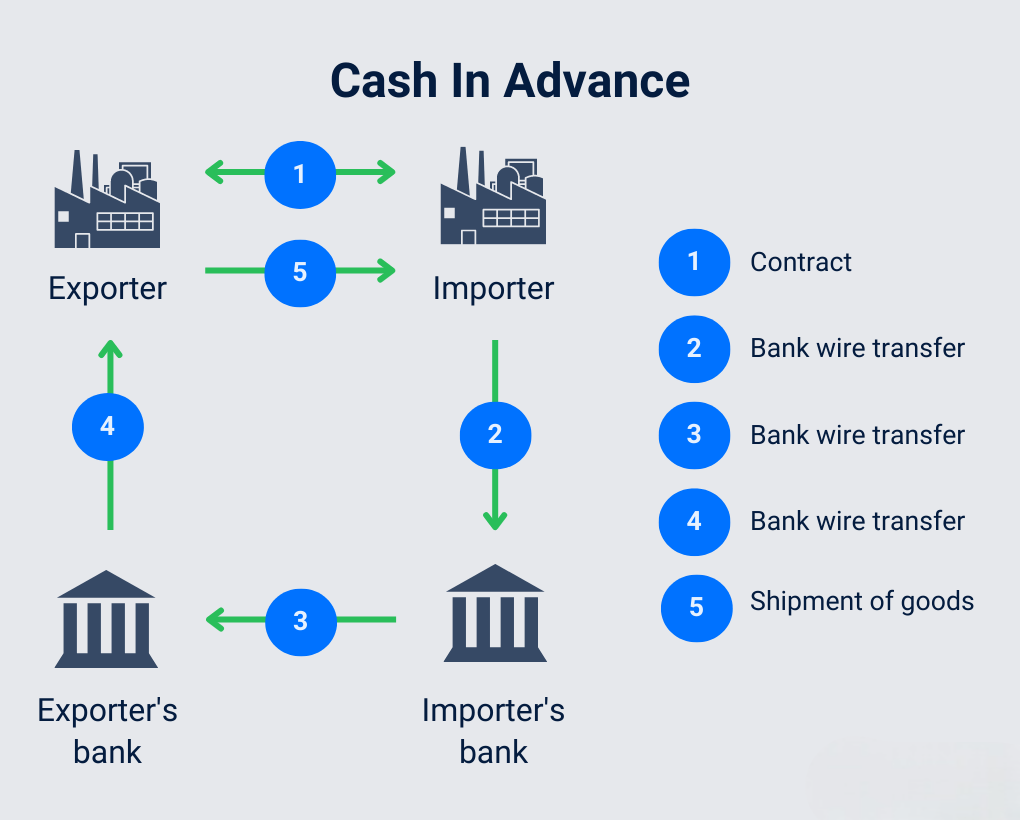
1. Cash In Advance (C-I-A): Maximum Security for the Exporter
| Risk Profile | Security (Exporter) | Attractiveness (Importer) |
| High Trust / Low Risk | Highest | Lowest |
What is it?
The buyer pays the seller the full amount, or a significant portion (e.g., 50% deposit), before the goods are shipped. Payments are typically made via Wire Transfer (Telegraphic Transfer/T/T) or sometimes, for smaller B2C transactions, credit cards.
Globax Advantage Point
Zero Risk of Non-Payment: Your cash flow is secured before you incur the major costs of shipping and production.
Best For: New buyers, small-value orders, and markets with high political or economic instability.
The Trade-Off
Insisting on C-I-A can be a competitive disadvantage, as it puts all the risk on the buyer, who is paying for goods sight unseen. You may lose business to competitors offering better terms.
2. Letter of Credit (L/C): The Gold Standard of Guaranteed Payment
| Risk Profile | Security (Exporter) | Attractiveness (Importer) |
| Balanced (Bank-Guaranteed) | High | Medium |
What is it?
An L/C is a legally binding commitment, issued by the buyer’s bank, that guarantees payment to the exporter. The payment is made only after the exporter presents the stipulated shipping documents (e.g., Bill of Lading, Commercial Invoice) to their bank, proving the goods have been shipped as agreed.
Globax Advantage Point
Bank Guarantee: Payment risk shifts from the buyer to the issuing bank. This is ideal for large, first-time transactions where the buyer’s creditworthiness is unverified.
Irrevocable L/C: This standard form cannot be canceled or modified without the consent of all parties, offering robust security.
The Trade-Off
L/Cs are document-intensive, complex, and carry higher bank fees than other methods. Any small discrepancy in the documents can lead to payment delays or refusal.
3. Documentary Collection (D/C): A Cost-Effective Compromise
| Risk Profile | Security (Exporter) | Attractiveness (Importer) |
| Moderate Trust / Moderate Risk | Medium | Medium |
What is it?
Banks act as intermediaries to facilitate the exchange of documents for payment, but they do not guarantee payment. The exporter’s bank (remitting bank) sends the shipping documents to the importer’s bank (collecting bank).
There are two main types:
Documents Against Payment (D/P) / Sight Draft: The buyer can only obtain the shipping documents (needed to claim the goods) from their bank upon immediate payment.
Documents Against Acceptance (D/A) / Time Draft: The buyer obtains the documents after accepting a draft, which is a promise to pay at a specified future date (e.g., 30 days).
Globax Advantage Point
Less Costly and Complex than L/C: It’s a smoother, more affordable transaction process.
Best For: Transactions with established partners in stable markets, offering a middle ground between L/C and Open Account.
The Trade-Off
The bank’s role is purely administrative. If the buyer defaults on their promise (especially with D/A), the exporter still bears the risk and the cost of having goods stuck at customs.
4. Open Account (O/A): Maximum Flexibility for the Importer
| Risk Profile | Security (Exporter) | Attractiveness (Importer) |
| Low Trust / High Risk | Lowest | Highest |
What is it?
The exporter ships the goods and all necessary documents directly to the importer. Payment is due at a later, agreed-upon date—typically 30, 60, or 90 days after shipment.
Globax Advantage Point
Highly Competitive: This is the preferred method for most international buyers, making your terms highly attractive and helping you win business against competitors.
Best For: Long-standing, highly trusted buyers in economically and politically stable markets.
The Trade-Off
This is the highest risk for the exporter, as the goods are in the buyer’s possession before payment is received. To mitigate this risk, Globax Solutions strongly recommends obtaining Export Credit Insurance (ECGC) before offering Open Account terms.
Conclusion: Partner with Globax Solutions for Financial Certainty
Choosing your payment terms is not a one-size-fits-all decision. It requires a careful assessment of:
Buyer Relationship: New vs. established partner.
Market Risk: Stable country vs. high-risk region.
Transaction Size: Small vs. multi-million dollar deals.
Contact us for more details of & Your registration
Our team will be happy to assist you
Mobile: +91-790-200-2800