 info@globaxsolutions.com
  +91-790-200-2800
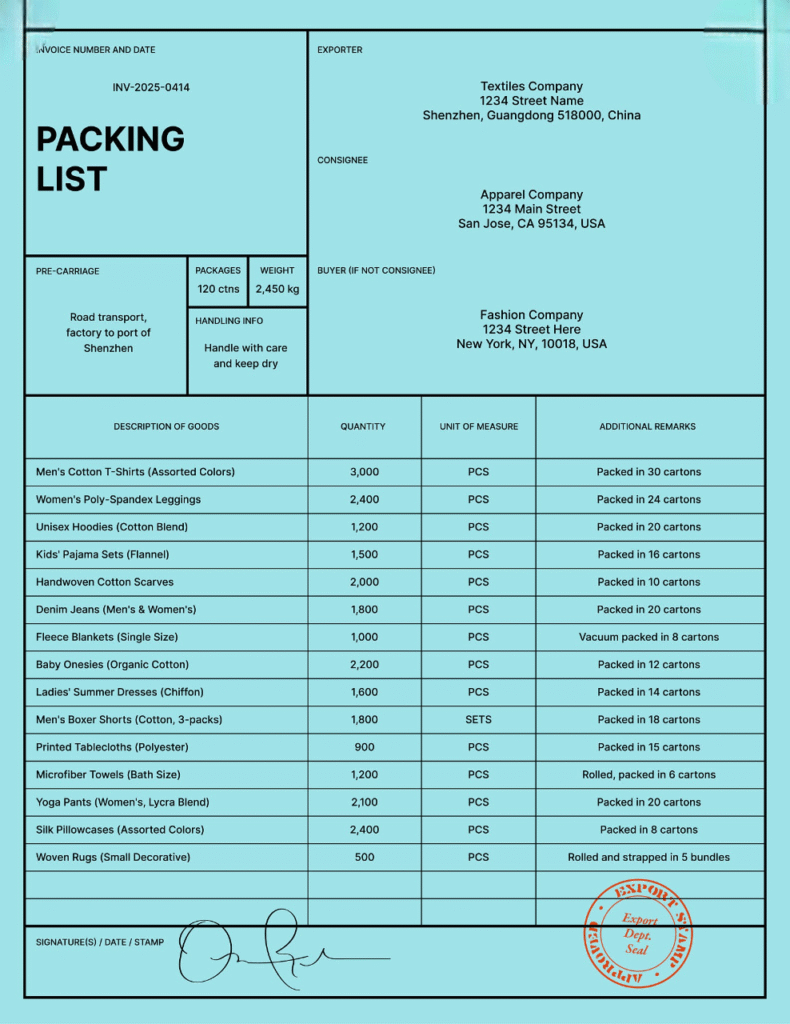
Zero Delays, Zero Fines: Mastering the Export Packing List Format (Globax Solutions Guide)
Why the Packing List is More Than Just an Inventory
Many exporters see the packing list as a simple inventory. In reality, it serves multiple critical functions that directly impact your bottom line:
Customs Clearance: It verifies the physical contents of the shipment against the Commercial Invoice and Bill of Lading, preventing holds and inspections.
Freight & Handling: Freight forwarders and port operators use the gross weight and dimensions (CBM) to calculate space, arrange loading, and ensure safe handling.
Insurance Claims: In case of damage or loss, insurance providers require an accurate packing list to validate the claim value.
Importer Compliance: It allows your buyer (the consignee) to cross-check the received items and process their local customs clearance efficiently.
The Mandatory Export Packing List Format
A compliant Export Packing List must be meticulously detailed and match all other shipping documents exactly. Here is the structure recommended by Globax Solutions:
| Section | Mandatory Information | Why It’s Crucial |
| I. IDENTIFICATION | Packing List Number, Date, Shipper (Exporter) Details (incl. IEC, GSTIN), Consignee Details, Notify Party. | Provides the core legal and contact information for the transaction. |
| II. TRANSPORT DETAILS | Vessel/Flight No., Port of Loading (Origin), Port of Discharge (Destination), Final Destination, B/L or AWB Number. | Links the physical goods to the specific transport journey and carrier record. |
| III. GOODS INVENTORY | Marks & Numbers (External carton ID), Quantity of Packages, Package Type (Cartons, Pallets), Description of Goods. | The detailed list used for physical verification at customs checkpoints. |
| IV. WEIGHT & MEASUREMENTS | Net Weight (KGS): Goods only. Gross Weight (KGS): Goods + Packaging. Dimensions (L x W x H): Per package. | Used to calculate freight cost (based on gross weight or CBM, whichever is higher) and assess duties. |
| V. SUMMARY & SIGNATURE | TOTAL Gross Weight, TOTAL Net Weight, TOTAL Volume (CBM/CFT), and the Authorized Signature of the Exporter. | Confirms the total metrics required for the Bill of Lading and customs manifest. |
Globax Solutions: Three Best Practices to Ensure Accuracy
Even a small error on the packing list can derail an entire shipment. Follow these professional best practices:
1. Always Calculate Volume (CBM)
Freight charges are often calculated based on volumetric weight. Your packing list must accurately display the volume in cubic meters (CBM) using the dimensions of your largest package.
2. Match the Commercial Invoice Line-by-Line
Every product description and quantity mentioned on the packing list must correspond exactly to the line items on the Commercial Invoice. If your packing list shows 100 boxes and your invoice shows 99, be prepared for a customs hold.
3. Use Clear Marks and Numbers
Ensure that the “Marks & Numbers” on the packing list (e.g., C/1 of 100, C/2 of 100) are physically marked on the outside of every carton. This makes it easy for warehouse workers at the destination to identify your cargo quickly, especially if the shipment is LCL (Less-than-Container Load).
Contact us for more details of & Your registration
Our team will be happy to assist you
Mobile: +91-790-200-2800