 info@globaxsolutions.com
  +91-790-200-2800
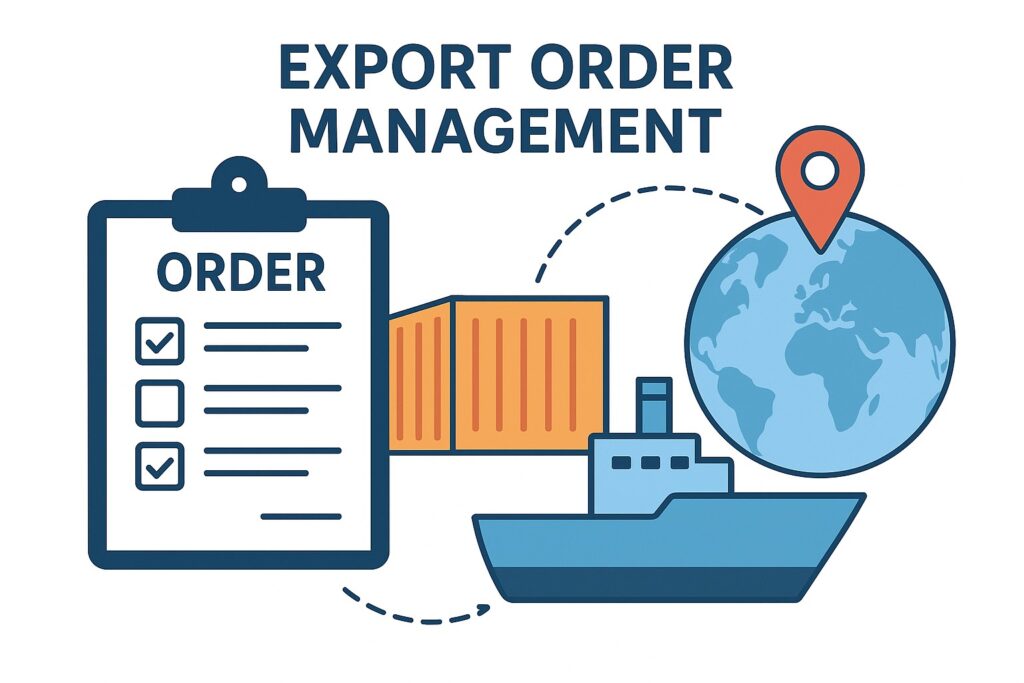
Mastering the Export Order Management Lifecycle
. Stage 1: Order Validation and Preparation
The moment a foreign PO is received, your EOM process must kick in with stringent checks. Failure here can derail the entire shipment.
Financial & Compliance Check:
Verify Payment Terms: Is the agreed-upon method (Letter of Credit, Open Account, Wire Transfer) secured and viable?
Screen Buyers: Run the buyer and the final destination against international denied party lists and export control regulations to avoid severe penalties (Mistake 5 from our last blog!).
Product Preparation:
Confirm inventory availability or production lead times.
Finalize HS Codes and ensure they align with the buyer’s country requirements for accurate duty calculation.
2. Stage 2: Documentation & Licensing
The volume and complexity of required documents often overwhelm exporters. Precision and consistency are non-negotiable.
The Foundational Documents: Accurately prepare the Commercial Invoice, Packing List, and Certificate of Origin. Ensure every detail—weights, Incoterms, currency—is identical across all forms.
Transport Contracts: Prepare the Shipper’s Letter of Instruction (SLI) to accurately guide your freight forwarder in creating the Bill of Lading (B/L) or Air Waybill (AWB).
Special Licenses: Secure any necessary export licenses or specific import permits required by the destination country (e.g., for food, electronics, or specialized machinery).
The EOM Challenge: Managing multiple versions of these documents while adhering to country-specific formats is a huge manual burden prone to human error.
3. Stage 3: Logistics Execution and Booking
This stage transitions from paperwork to physical movement, demanding tight coordination between sales, warehousing, and the carrier.
Carrier Selection & Booking: Based on the agreed-upon Incoterm (e.g., FCA or CFR), select the optimal carrier (ocean, air, or multi-modal) and schedule the booking.
Customs Filing (Export): File the required declaration with your domestic customs agency. This is typically done electronically and must be completed before the goods leave the country.
Pre-Shipment Inspection (PSI): If required by the buyer or a Letter of Credit, arrange for an independent third-party inspection to verify quantity and quality before the container is sealed.
4. Stage 4: Tracking, Final Delivery, and Proof
The order isn’t complete until the goods are safely in the buyer’s hands and the transaction is financially settled.
Real-Time Tracking: Maintain continuous visibility of the shipment in transit, proactively informing the buyer of potential delays or schedule changes.
Customs Clearance (Import): Coordinate with the importing customs broker (if applicable under the chosen Incoterm) to ensure all necessary local duties and fees are handled efficiently.
Proof of Delivery (POD) & Payment: Obtain the final POD. If utilizing a secure payment instrument like an L/C, present all required, original documents to your bank to finalize payment.
The Globax Solutions Difference: Integrated EOM
Many companies manage their export orders using fragmented systems: spreadsheets for inventory, email for carrier communication, and paper for documents. This siloed approach creates gaps where errors thrive.
Globax Solutions provides an integrated EOM platform that brings all these stages together.
We eliminate the chaos by offering:
Centralized Documentation: One single source of truth for all required forms, auto-populating fields and ensuring consistency.
Compliance Automation: Real-time checking against restricted party lists and automatic alerts for missing licenses.
End-to-End Visibility: A single dashboard that tracks every order, from the moment of validation through customs clearance and final payment.
Contact us for more details of & Your registration
Our team will be happy to assist you
Mobile: +91-790-200-2800