 info@globaxsolutions.com
  +91-790-200-2800
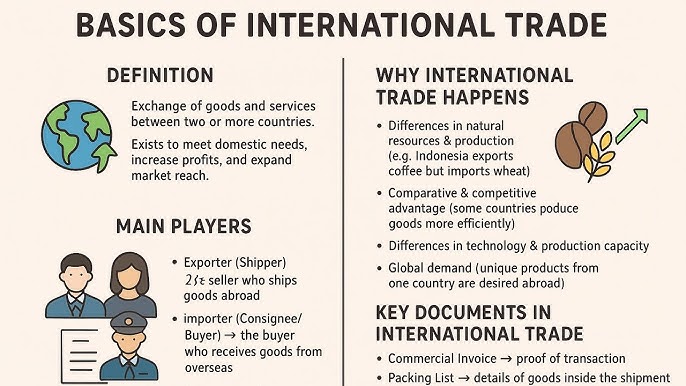
International Trade Basics: Your Essential Glossary and Guide to Global Commerce
Introduction: The Language of Global Commerce
Hook: International trade is the backbone of the modern global economy, influencing everything from the price of your coffee to the design of your electronics. While it may seem complex, the underlying principles are logical and learnable.
Globax Value: At Globax Solutions, we believe that understanding the basics is the first step toward building a successful and compliant international business.
Promise: This guide will simplify the core concepts, economic theories, and practical terms you need to know to confidently engage in cross-border commerce.
Part I: Core Concepts and Terminology
1. Exports vs. Imports
Exports: Goods and services sold by a domestic country to a foreign country. (When you sell abroad, you are an exporter).
Imports: Goods and services brought into a domestic country from a foreign country. (When you buy from abroad, you are an importer).
2. Trade Balance
The difference between a country’s total value of exports and its total value of imports over a specific period.
Trade Surplus: When Exports > Imports (More money flowing into the country).
Trade Deficit: When Imports > Exports (More money flowing out of the country).
3. Tariffs and Quotas
These are the primary tools governments use to manage trade:
Tariff: A tax or duty paid on a specific class of imports or exports. Tariffs make imported goods more expensive, protecting domestic industries.
Quota: A limit placed on the quantity of a specific good that can be imported or exported during a defined time period.
Part II: The Economic Engine of Trade
4. Comparative Advantage (Why Trade Happens)
This is the single most important concept in international trade.
Definition: A country has a comparative advantage if it can produce a specific good or service at a lower opportunity cost than another country.
Result: Trade benefits everyone when each country specializes in producing and exporting the goods for which it has a comparative advantage, even if one country is better at producing everything (Absolute Advantage). This specialization leads to greater overall efficiency and output globally.
5. Foreign Exchange and Currency Risk
All international transactions involve converting currencies, creating inherent financial risk.
Exchange Rate: The price of one country’s currency in terms of another currency (e.g., $1 USD = ₹83 INR).
Appreciation/Depreciation: Fluctuations in exchange rates directly impact the profitability of international deals. For exporters, a stronger local currency can make their goods more expensive abroad, while a weaker currency makes them cheaper.
Part III: The Practical Basics of Global Logistics
The following terms are vital for every exporter and importer.
6. HS Code (Harmonized System Code)
What it is: A globally standardized system of names and numbers for classifying traded products. It is managed by the World Customs Organization (WCO).
Why it matters: Every product has an HS Code (usually 6-10 digits). This code determines the duty/tariff rate a product faces in the importing country and is required on all customs documentation.
7. Incoterms (International Commercial Terms)
These are the most critical set of rules defining the responsibilities of buyers and sellers in international transport.
Definition: A set of 11 pre-defined commercial terms published by the International Chamber of Commerce (ICC).
What they govern:
Cost: Who pays for freight, insurance, and duties.
Risk: The point at which the responsibility (risk of loss or damage) transfers from the seller (exporter) to the buyer (importer).
Key Example: Under FOB (Free On Board), the seller’s cost and risk end when the goods are loaded onto the ship.
8. Key Documentation
Every shipment requires accurate paperwork:
Commercial Invoice: The bill for the goods.
Packing List: Details the contents of each package.
Bill of Lading (B/L) / Air Waybill (AWB): The contract between the shipper and the carrier, acting as a title document for the goods.
Certificate of Origin: Certifies where the goods were produced.
Contact us for more details of & Your registration
Our team will be happy to assist you
Mobile: +91-790-200-2800
