 info@globaxsolutions.com
  +91-790-200-2800
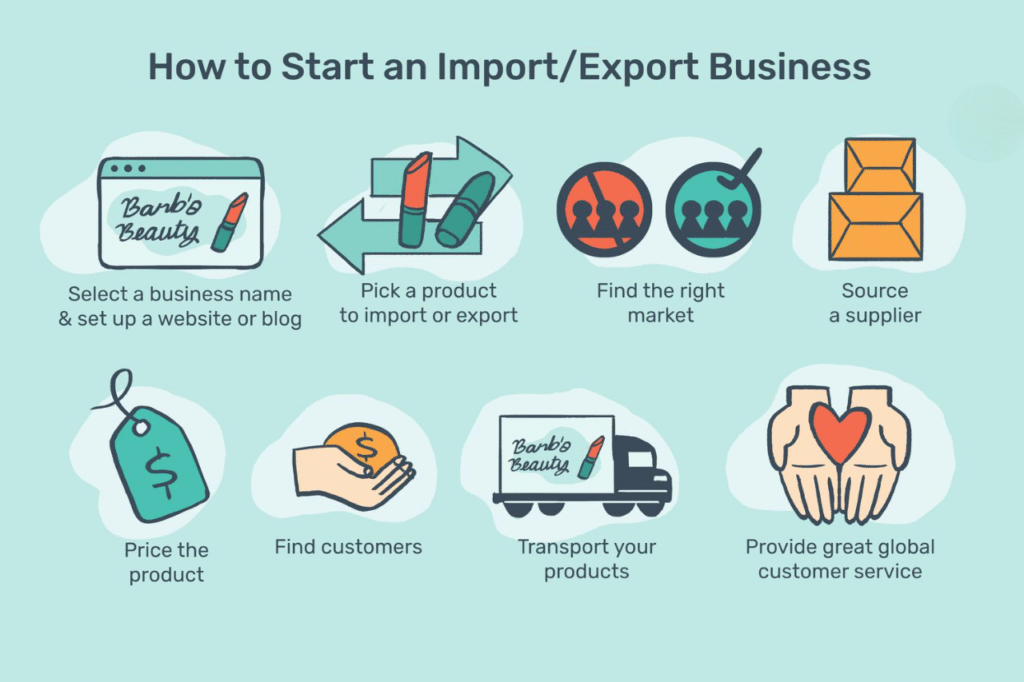
The Import-Export Beginner’s Guide: Your 8-Step Roadmap to Global Trade
Phase 1: Legal Setup and Product Strategy
Step 1: Lay the Legal Foundation
Before you can trade, you must formalize your business structure.
Establish Your Entity: Decide on your business structure: Sole Proprietorship, Partnership, LLP (Limited Liability Partnership), or Private Limited Company. The choice affects liability and tax structure.
Obtain PAN and Current Account: A Permanent Account Number (PAN) in the name of your business is mandatory. Next, open a Current Bank Account with a bank authorized to deal in foreign exchange (an Authorized Dealer Bank).
Get GST Registration: While exports are “zero-rated,” GST registration is necessary to claim refunds on the Input Tax Credit (ITC) for the raw materials or services used in the goods you export.
Step 2: Secure Your Import Export Code (IEC)
This is the mandatory license required to transact international trade.
What it is: The IEC is a unique 10-digit code issued by the Directorate General of Foreign Trade (DGFT). It is a one-time registration with lifetime validity.
Requirement: You cannot ship or receive goods, nor can you benefit from most government export promotion schemes, without a valid IEC.
AD Code Registration: Simultaneously, you must register your AD (Authorized Dealer) Code with Customs at every port from which you plan to ship your goods. This is crucial for customs clearance and receiving export benefits.
Step 3: Select Your Winning Product
Don’t rush this step. It is the most common reason for beginner failure.
Market-Driven Selection: Use trade data tools (like ITC Trade Map) to find products with verified high demand in foreign markets and low domestic competition.
Check Regulations: Ensure your product is freely exportable/importable (not on the Prohibited or Restricted Lists). Check for any product-specific licensing (e.g., FSSAI for food products, BIS for electronics).
The GlobaX Rule: Focus on a product that gives you a competitive advantage—either in price, quality, or uniqueness.
Phase 2: Market & Logistics Execution
Step 4: Find and Verify Buyers/Suppliers
Getting the order (or finding a reliable source) is the heart of the business.
Active Prospecting: Use digital marketing tools like LinkedIn Sales Navigator and curated WhatsApp Groups to connect directly with decision-makers.
Trade Promotion: Register with an Export Promotion Council (EPC) or FIEO (Federation of Indian Export Organisations) to obtain an RCMC (Registration-cum-Membership Certificate). This allows you to claim incentives and participate in subsidized trade fairs/delegations.
Due Diligence: Always vet potential partners by checking their online footprint, trade references, and import/export history (if using paid data services).
Step 5: Master Pricing and Incoterms
A common mistake is miscalculating the final landed cost.
Costing Sheet: Prepare a detailed Export Costing Sheet that includes production cost, domestic taxes/duties, packaging, freight, insurance, and profit margin.
Incoterms: Understand and clearly define the Incoterm (e.g., FOB, CIF, or EXW) in your quote. Incoterms define precisely who pays for which part of the journey and, more importantly, where the risk transfers from seller to buyer.
Quotation: Issue a formal Pro Forma Invoice detailing all specifications and agreed-upon terms.
Step 6: Secure Payment Terms
Financial risk management is critical.
New Buyers: Push for highly secure methods like Advance Payment (30-50%) or Letter of Credit (LC). LC is complex but offers the highest security, guaranteeing payment if you submit compliant documents.
Trusted Buyers: You may move to slightly riskier but faster methods like Document Against Acceptance (DA) or Document Against Payment (DP) for long-term partners.
ECGC: Consider getting an ECGC (Export Credit Guarantee Corporation) policy to insure against non-payment risk by foreign buyers.
Phase 3: Finalizing the Shipment
Step 7: Manage Logistics and Documentation
This is where the theoretical trade becomes physical.
Freight Forwarder: Hire a reliable Freight Forwarder—they are your partners on the ground, handling transportation, port formalities, and booking the vessel or flight.
Key Documents: Prepare the essential documents flawlessly: Commercial Invoice, Packing List, Bill of Lading (B/L) / Airway Bill (AWB), and Certificate of Origin.
Customs Filing: Your Customs Broker will file the Shipping Bill (for exports) or the Bill of Entry (for imports) with the Customs Department. Accuracy is non-negotiable here.
Step 8: Shipment Tracking and Post-Sales
Tracking: Track your consignment until it clears customs at the final destination. Keep the buyer updated with shipping milestones.
Realization: Ensure your bank receives the payment and issues the Bank Realization Certificate (BRC)—proof that you’ve received the payment in foreign exchange, required under FEMA (Foreign Exchange Management Act) guidelines.
Claiming Benefits: Use your RCMC, Shipping Bill, and BRC to apply for export incentives like RoDTEP or GST refunds.
Contact us for more details of & Your registration
Our team will be happy to assist you
Mobile: +91-790-200-2800
