 info@globaxsolutions.com
  +91-790-200-2800
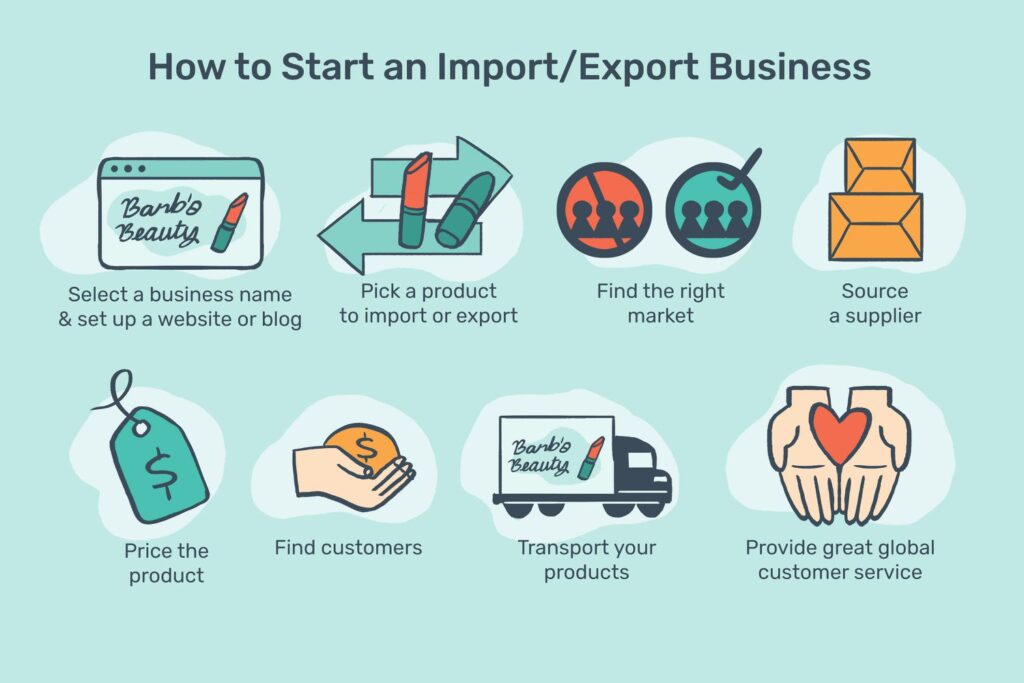
Essential Requirements for Starting an Import Export Business in India
1. Business Entity Registration & PAN
You must legally register your company. The structure you choose (Sole Proprietorship, Partnership, LLP, or Private Limited Company) affects liability and compliance. Regardless of the structure, obtaining a Permanent Account Number (PAN) from the Income Tax Department is mandatory.
2. Open a Current Account
All international transactions must be processed through a dedicated business bank account. You must open a Current Account with a bank authorized to deal in Foreign Exchange (an AD Category I bank). This account is crucial for receiving export proceeds and is required for IEC registration.
3. The Mandatory IEC (Import Export Code)
This is the single most important requirement for global trade.
What it is: A 10-digit code issued by the Directorate General of Foreign Trade (DGFT).
Why it’s essential: No person or entity can make any import or export without an IEC. The entire application is now online and PAN-based.
4. GST Registration
While not always mandatory for export (since exports are typically zero-rated supplies), a GSTIN is highly advisable. It is required for most domestic sourcing and for claiming tax refunds on goods and services used for export.
Phase 2: Strategic and Operational Requirements
Once the legal groundwork is complete, focus shifts to strategic execution.
5. Product and Market Selection
Your success depends on what you sell and where you sell it.
Product: Research trending commodities where India has a competitive advantage (e.g., textiles, pharmaceuticals, engineering goods, spices). Ensure your product is freely exportable and check if any product-specific licenses (like FSSAI for food) are needed.
Market: Conduct research on market size, competition, and trade barriers (Non-Tariff Measures or NTMs) in your target country.
6. RCMC (Registration-cum-Membership Certificate)
To avail of benefits, incentives (like RoDTEP), concessions, and authorizations under the Foreign Trade Policy, you must register with the appropriate Export Promotion Council (EPC) or Commodity Board related to your product (e.g., APEDA for food, EEPC for engineering). This registration gives you the RCMC.
7. Financial & Risk Management
International trade carries inherent financial risks.
Working Capital: Estimate the initial investment needed for product sourcing, sampling, logistics, and marketing.
Risk Cover: Secure coverage from the Export Credit Guarantee Corporation (ECGC) to safeguard against non-payment by foreign buyers.
Secure Payments: Understand and insist on secure payment methods like Letter of Credit (L/C) or advance payments.
Phase 3: Logistics and Compliance Requirements
This phase ensures goods move smoothly and legally across borders.
8. Logistics and Freight Forwarder
You need reliable partners to manage the physical movement of goods. A qualified Freight Forwarder helps you:
Navigate Incoterms® (FOB, CIF, etc.).
Manage customs clearance (filing the Shipping Bill on the ICEGATE portal).
Book competitive ocean or air freight.
9. Mandatory Documentation Expertise
Mastering the documentation process is a requirement in itself. You must be able to generate and manage documents flawlessly, including the Commercial Invoice, Packing List, Bill of Lading/Airway Bill, and Certificate of Origin.
Globax Solutions: Your Partner in Global Compliance
The list of requirements for an Import Export business is extensive, but they are all manageable with the right expertise. At Globax Solutions, we specialize in simplifying this complexity.
We provide comprehensive support for:
IEC and RCMC registration.
End-to-end documentation audit and preparation.
Training on compliance with the latest DGFT policies.
Contact us for more details of & Your registration
Our team will be happy to assist you
Mobile: +91-790-200-2800