 info@globaxsolutions.com
  +91-790-200-2800
Import-Export Course in Mathura
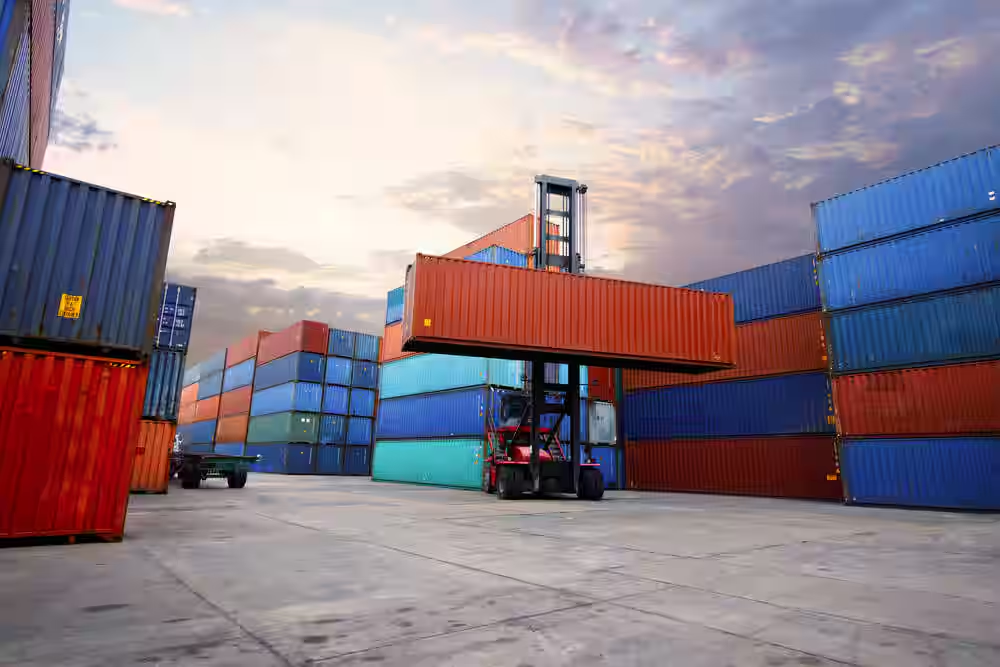
Why an Import-Export Course in Mathura is Your Next Big Step with Globax Solutions
What a Comprehensive Import-Export Course Covers
A quality training program, particularly one focusing on practical implementation like Globax Solutions’ offerings, ensures you cover all the critical stages of global trade.
1. Legal and Business Setup: The Foundation
Before shipping your first product, you need a solid legal base. This module provides a complete roadmap for legal compliance:
IEC Code Application: The mandatory 10-digit Importer Exporter Code (IEC) from the DGFT (Directorate General of Foreign Trade). The course provides step-by-step guidance on its online submission.
Registration & Compliance: Obtaining your PAN, GST Registration (essential for claiming Input Tax Credit), and AD Code Registration with Customs at your chosen ports.
RCMC: Guidance on registering with an Export Promotion Council (EPC) to obtain the Registration-cum-Membership Certificate, which is necessary to avail government benefits.
2. Product Strategy and Market Research
Knowing what to sell and where to sell it is the difference between a successful business and a stalled one.
HS Code Mastery: Learning to accurately classify your product using the Harmonized System (HS) Code—critical for correct duty calculation and documentation globally.
Global Market Selection: Using professional tools and market data to identify countries with high demand and low competition for your chosen products.
3. Documentation, Shipping, and Logistics
Documentation errors are the most common cause of shipment delays and penalties. Mastery of paperwork is paramount.
Key Documents: In-depth, practical training on preparing and submitting documents like the Commercial Invoice, Packing List, Bill of Lading (BL), and Certificate of Origin (CoO).
Incoterms 2020®: Detailed understanding of the International Commercial Terms (Incoterms) like FOB, CIF, and DDP, which clearly define the transfer of cost and risk between the buyer and seller.
Customs Clearance: Understanding the roles of the Freight Forwarder and Customs House Agent (CHA) and navigating the electronic data interchange (EDI) system for smooth port operations.
4. International Finance and Risk Management
Getting paid securely and maximizing your returns is the ultimate goal.
Payment Security: A deep dive into international payment methods, from the high security of a Letter of Credit (LC) to the speed of Telegraphic Transfer (TT), and how to choose the right method.
Government Incentives: Learning to practically file and claim export incentives like the RoDTEP (Remission of Duties and Taxes on Exported Products) scheme to ensure you reclaim every penny of your embedded taxes.
Forex Management: Basics of foreign exchange to understand currency risk and profitability.
📈 The Globax Solutions Advantage: Practical Learning, Global Leads
Globax Solutions stands out by offering a highly practical, implementation-focused training model that addresses the needs of modern traders:
| Feature | Theory-Based Courses | Globax Solutions Training |
| Focus | General trade theory, historical docs | Compliance, Digital Marketing, and Costing |
| Mentorship | Limited/Generic | Industry-Experienced Experts (Active exporters, DGFT consultants) |
| Digital Skills | Absent or basic | Digital Marketing for Global Lead Generation (LinkedIn B2B, International SEO) |
| The Result | Theoretical knowledge | The ability to ship your first order confidently |
By focusing on a curriculum that includes Digital Marketing for Exporters—strategies like international B2B lead generation on LinkedIn and building an SEO-optimized export website—Globax Solutions equips you with the modern tools needed to find and convert international buyers.
🌟 Benefits: Beyond a Certificate—A Global Career
Enrolling in an Import-Export course is the fastest and most secure way to enter global trade. The benefits are manifold:
Start Your Own Global Business: Gain the complete blueprint to launch your own import or export venture from Mathura, reducing the risk of costly beginner mistakes.
High-Value Career Path: Unlock job roles in high-demand fields like Logistics, Supply Chain Management, Foreign Trade Analysis, and Customs Consultancy within India and abroad.
Risk Mitigation: Learn how to use instruments like the Export Credit Guarantee Corporation (ECGC) policy to insure against non-payment risks from foreign buyers.
Maximize Profit: Master the complexities of tariffs, duties, and incentives to ensure your pricing is competitive and your profit margins are maximized.
✅ Ready to Go Global from Mathura?
The opportunity to turn Mathura’s rich heritage and growing industry into a global export brand is now. With comprehensive, practical training from Globax Solutions, you get the knowledge, the tools, and the lifelong support system to confidently make the leap into the exciting world of international trade.
Contact us for more details of & Your registration
Our team will be happy to assist you
Mobile: +91-790-200-2800